Pain or Recurrent Swelling
Repeated inflammation around a partially erupted wisdom tooth is a common reason for specialist evaluation.
 DR. PATADIYA DENTAL CLINICGANDHINAGAR · GUJARATBook Appointment


Specialist evaluation for painful, impacted or problematic wisdom teeth with clear explanation, careful planning and comfort-focused care.
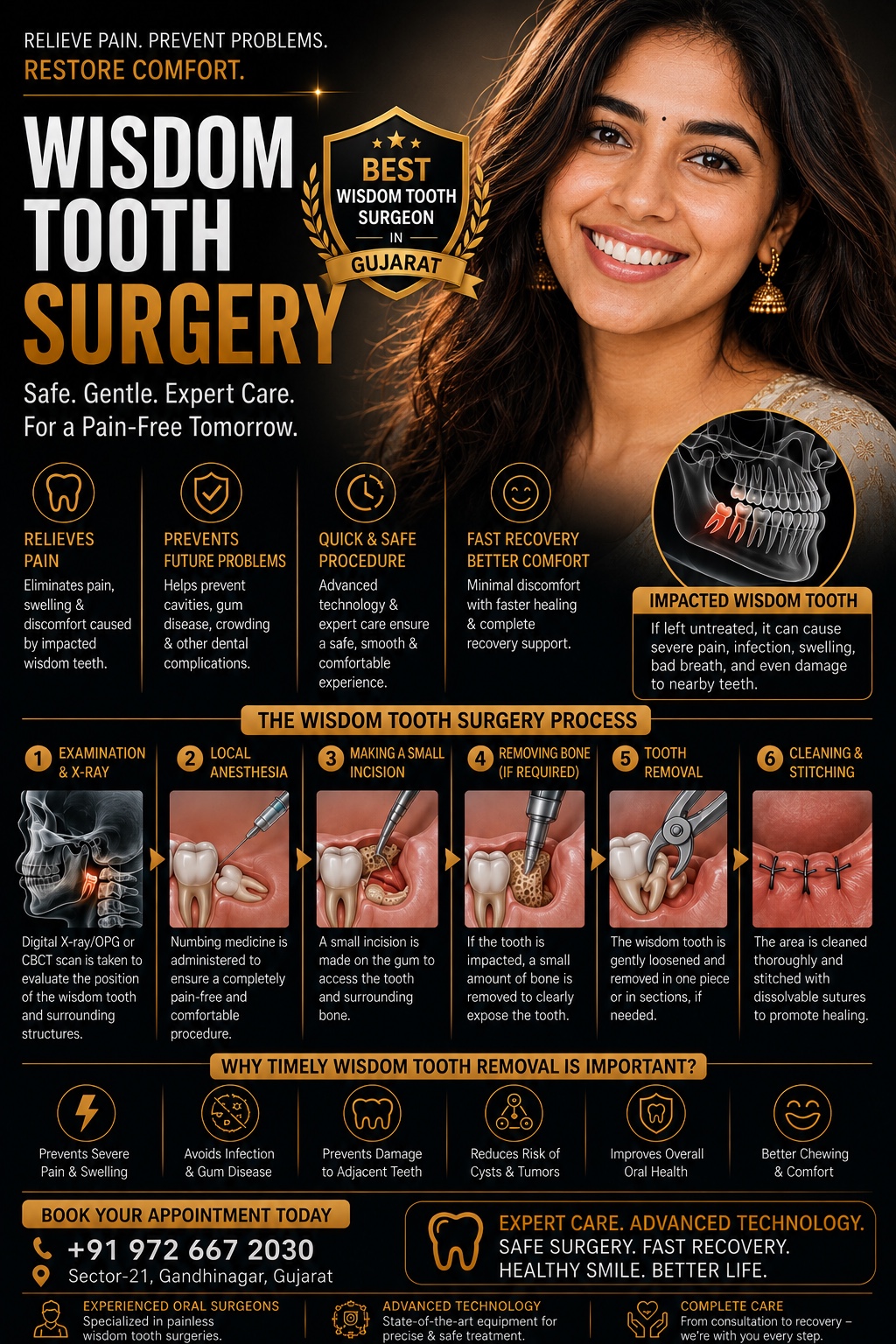
Wisdom teeth can remain healthy and symptom-free, or they may contribute to pain, recurrent swelling, food trapping, decay, gum inflammation or problems affecting nearby teeth. The recommendation depends on the individual tooth and clinical findings.
Repeated inflammation around a partially erupted wisdom tooth is a common reason for specialist evaluation.
A wisdom tooth may remain partly or completely trapped within gum or bone and may require treatment depending on position and symptoms.
In some cases, the position of a wisdom tooth may contribute to decay, gum problems or damage affecting the tooth in front of it.
Food trapping, recurrent infection and difficulty keeping the area clean may influence the decision to treat.
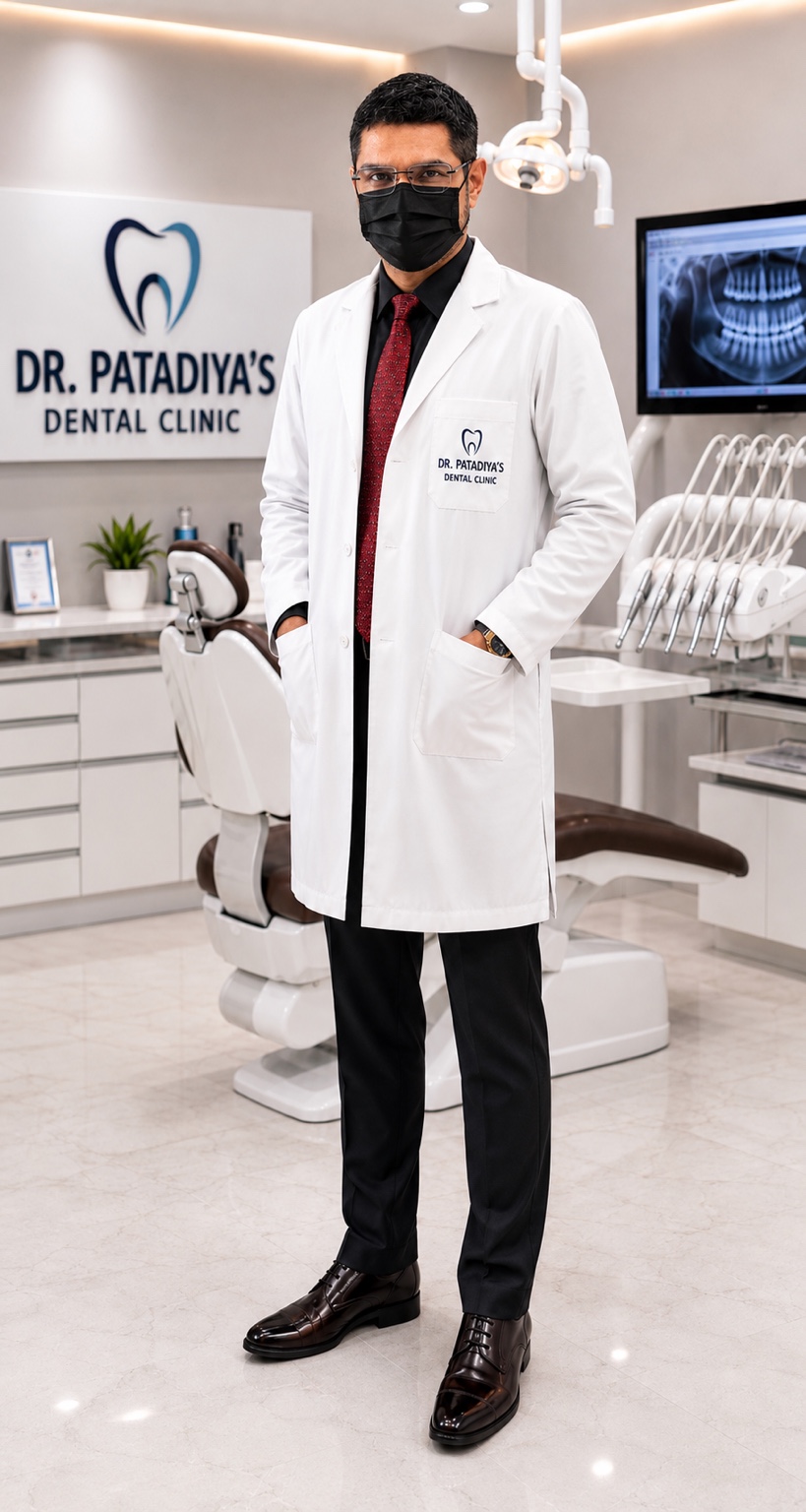
Dr. M. M. Patadiya, B.D.S., M.D.S. — Senior Oral & Maxillofacial Surgeon & Advanced Dental Practitioner has extensive experience in wisdom tooth care across his professional career.
His clinic-reported career-wide estimate is approximately 25,000+ wisdom tooth cases across his work in Gandhinagar, Ahmedabad and other cities of Gujarat. This is not presented as a count limited only to Dr. Patadiya Dental Clinic.
His approach is to keep the patient experience reassuring: proper assessment, clear explanation, careful planning, appropriate anaesthesia, treatment when indicated and structured follow-up.
Symptoms, mouth opening, gum condition and the position of the wisdom tooth are evaluated.
Appropriate X-rays help assess root shape, tooth position, surrounding bone and nearby anatomical structures.
You are advised whether monitoring, local treatment or removal is the more appropriate option.
Post-treatment instructions are provided and follow-up is arranged according to the individual case.
Dr. M. M. Patadiya’s Oral & Maxillofacial Surgery qualification adds specialist depth, but his practice also includes dental implants, crowns and bridges, E-max and zirconia restorations, veneers, cosmetic dentistry, clear aligners, restorative care and comprehensive treatment planning.
No. Healthy wisdom teeth that are symptom-free and not causing disease may sometimes be monitored. Removal is based on clinical findings and individual risk.
An impacted wisdom tooth has not erupted normally and remains partly or completely trapped within gum or bone.
Imaging is commonly used to assess tooth position, root shape and nearby anatomy before a final recommendation is made.
Swelling, discomfort and healing time vary according to the tooth and individual patient. You receive post-treatment instructions and follow-up guidance.
Wisdom teeth, or third molars, may erupt normally, remain partly erupted or become impacted within the jaw. Removal is generally considered when a tooth causes pain, repeated infection, gum inflammation, food trapping, decay, damage to a neighbouring tooth or another clinically significant problem.
At DR. PATADIYA DENTAL CLINIC, assessment considers symptoms, tooth position, surrounding bone, nearby teeth and important anatomical structures. Appropriate dental imaging may be advised before treatment planning.
Symptoms, mouth opening, gum condition and the wisdom-tooth area are examined.
Radiographs or other imaging are used when appropriate to understand tooth position and nearby structures.
The procedure, anaesthesia, expected recovery, risks and aftercare are discussed before surgery.
Pain or tenderness • Recurrent swelling • Infection around a partially erupted tooth • Food trapping • Decay that cannot be predictably restored • Damage to the second molar • Cystic or other pathology when diagnosed • Other clinical indications.
An impacted wisdom tooth does not erupt into a normal functional position. The tooth may be vertical, angled forward or backward, or positioned more horizontally. The exact surgical approach depends on tooth orientation, root anatomy, bone coverage and relationship to nearby structures.
After appropriate anaesthesia, access is created to the tooth. Depending on its position, a small amount of surrounding bone may need to be removed and the tooth may be divided into sections for controlled removal. The site is cleaned and sutures may be placed when required.
Some discomfort and swelling can occur after surgical removal, particularly for impacted teeth. Written instructions may include pressure on gauze, appropriate cold application, prescribed medicines, soft foods, careful oral hygiene and avoiding smoking or activities that may disturb the healing site. Recovery differs from patient to patient and with surgical complexity.
DR. M. M. PATADIYA, B.D.S., M.D.S. (Oral & Maxillofacial Surgeon) is a senior Oral & Maxillofacial Surgeon in Gandhinagar with extensive experience in routine, impacted and surgically challenging third-molar cases. Across his professional clinical work in Gandhinagar, Ahmedabad and other cities of Gujarat, Dr. Patadiya has treated approximately 25,000+ wisdom tooth surgery cases. This clinic-reported professional experience figure is not limited to procedures performed at DR. PATADIYA DENTAL CLINIC.
Patients searching for the best wisdom tooth removal surgeon in Gandhinagar, best wisdom tooth surgeon in Gandhinagar, wisdom tooth specialist in Gandhinagar, Oral & Maxillofacial Surgeon in Gandhinagar, wisdom tooth surgeon near Ahmedabad or specialist wisdom tooth surgery in Gujarat should consider specialist qualifications, surgical experience, diagnosis, anatomy, sterilisation protocols and appropriate post-operative care. Dr. Patadiya’s M.D.S. specialist training and extensive third-molar surgical exposure support care for simple as well as difficult impacted wisdom teeth.
No. A healthy, symptom-free wisdom tooth that is functional and maintainable may not require removal. The decision is based on clinical findings and imaging where appropriate.
Local anaesthesia is used to numb the surgical area. Post-operative discomfort varies with the complexity of surgery and is managed with appropriate aftercare and medication when prescribed.
Recovery varies. Many patients improve progressively over several days, while more complex surgery can take longer. Your surgeon will advise you according to the procedure performed.
In some cases, an impacted or difficult-to-clean wisdom tooth can contribute to decay, gum problems or other damage around the neighbouring second molar.
Educational information only. Wisdom-tooth removal is not required in every case. Surgical difficulty, risks, healing time and need for additional imaging vary according to individual anatomy and clinical findings.
“Dr. Patadiya is a senior dentist in Gandhinagar and a wisdom tooth removal specialist. Very good experience.”
“Professional and caring treatment. My wisdom tooth removal was painless and the follow-up care was very good.”
“Dr. Patadiya removed my wisdom tooth without much pain. I had a very good experience.”
Excerpts from Google reviews supplied for this website. Individual experiences and outcomes vary.